
3-D microscopy downsampling study#
This case tests SplineOps on a real volume without presenting real-data proxies as ground truth. The result is encouraging for projection antialiasing, but it does not prove better biological measurements. The BBBC050 segmentation validation adds manual labels and embryo-level validation.
Data and task#
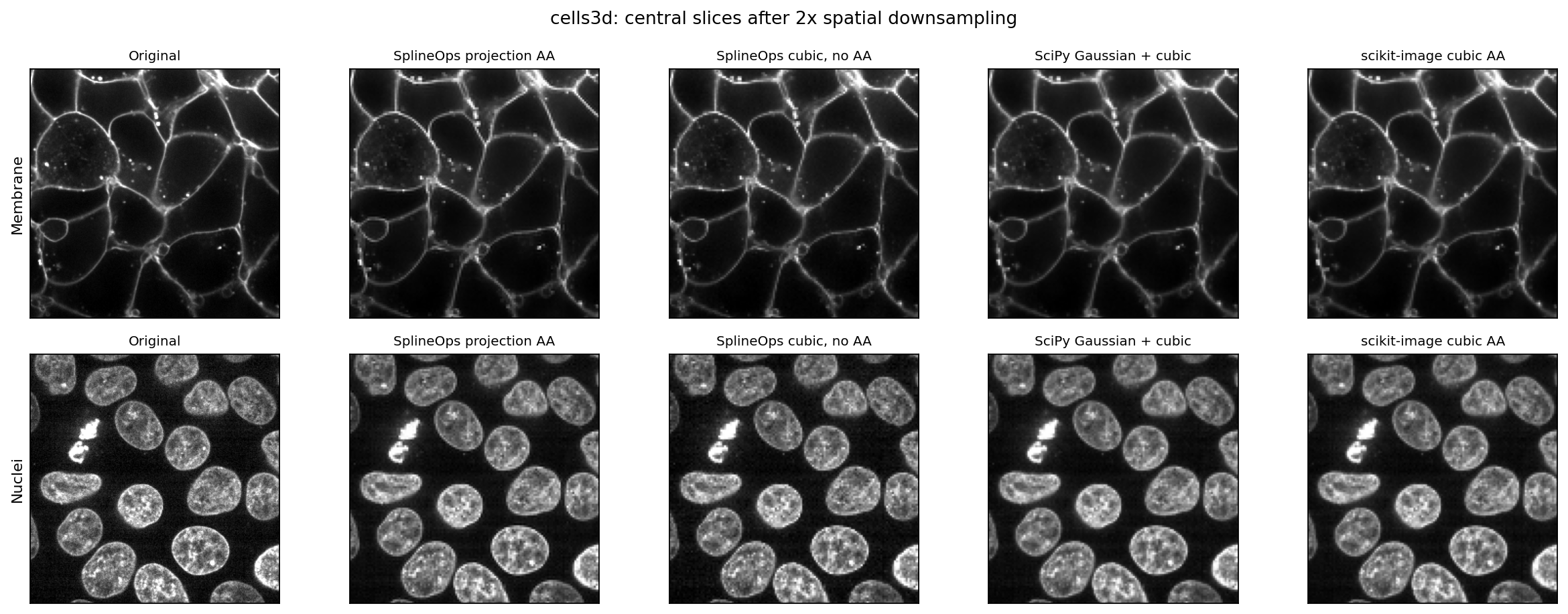
The input is the public cells3d sample distributed by scikit-image and
attributed to the Allen Institute for Cell Science. The data repository
marks cells3d.tif CC0. It has shape (60, 2, 256, 256) in ZCYX order:
one membrane channel and one nuclei channel. The documented voxel spacing is
(0.29, 0.26, 0.26) micrometres in ZYX order.
The study pins the source revision and SHA-256, then resizes only axes
(0, 2, 3) to (30, 128, 128). The channel axis stays unchanged. With
endpoint-aligned geometry, the resulting spacing is approximately
(0.590, 0.522, 0.522) micrometres.
For measurement and display, each channel is clipped at its 0.5th and 99.5th
percentiles and scaled to [0, 1]. The scikit-image sample was already
downsampled fourfold in X and Y before distribution; this is a convenient
real volume, not pristine acquisition data.
Methods and evidence#
All methods produce the same array shape, but they do not have identical grid or boundary semantics. The SciPy reference applies a scale-dependent Gaussian before endpoint-aligned cubic sampling. scikit-image uses its own resize grid.
The recorded run used one warm-up and three timed repetitions with one thread per numerical runtime. Times are end-to-end medians on one Linux workstation; they are not universal rankings.
Method |
Time (ms) |
Calibration NRMSE |
Round-trip PSNR |
High-band energy |
|---|---|---|---|---|
SplineOps projection AA |
160 |
0.0818 |
29.27 dB |
6.61% |
SplineOps cubic, no AA |
76 |
0.1372 |
28.04 dB |
7.40% |
SciPy Gaussian + cubic |
759 |
0.1004 |
28.57 dB |
4.42% |
scikit-image cubic AA |
897 |
0.0943 |
27.76 dB |
4.27% |
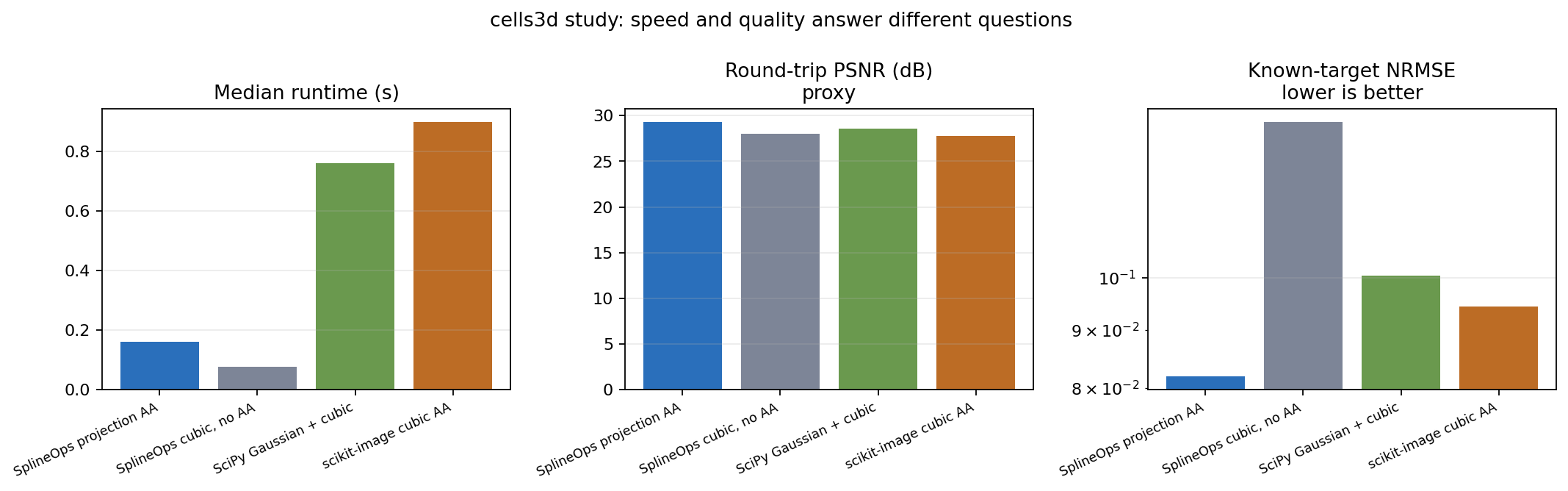
Calibration NRMSE is the strongest accuracy evidence here. It uses a
separate, mirror-compatible cosine field whose low-frequency output is known;
lower is better. The other two quality columns use the real cells volume:
round-trip PSNR measures recovery after one fixed cubic upsampling step, but can reward aliased detail;
high-band energy describes the output spectrum, but a lower value can mean either less aliasing or more blur.
Agreement with the Gaussian result and SSIM are also recorded in the raw artifact. They are not headline metrics because choosing the Gaussian output as the reference makes that method perfect by definition.
What this supports#
On this workload, projection antialiasing had the lowest known-target error and the highest round-trip PSNR. It ran about 4.7 times faster than the SciPy pipeline and 5.6 times faster than scikit-image, while taking about twice as long as cubic interpolation without antialiasing.
That supports SplineOps as a practical option for endpoint-aligned 3-D downsampling. It does not establish segmentation, registration, or measurement accuracy. Those require task-specific labels and validation. The central-slice differences are also subtle; the numerical case is stronger than a visual marketing claim.
Reproduce it#
The dataset is downloaded to the user cache, verified, and never vendored.
python -m pip install -e '.[study]'
python scripts/benchmark_cells3d_downsampling.py \
    --warmups 1 --repeats 3 \
    --output-dir benchmarks/cells3d
The benchmark script, JSON artifact, and CSV artifact contain the exact URL, checksum, environment, method semantics, and full-precision values.