
Modules#
Choose a tool for your task. All seven modules have stable NumPy/CPU APIs in SplineOps 2.3, with explicit numerical contracts. See API stability and support for supported precision, dimensions, and boundaries.
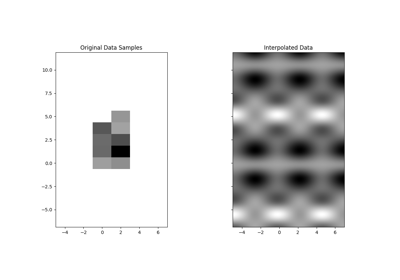
Build a continuous model from uniform samples and evaluate it at arbitrary points or grids. Reuse geometry across changing data.
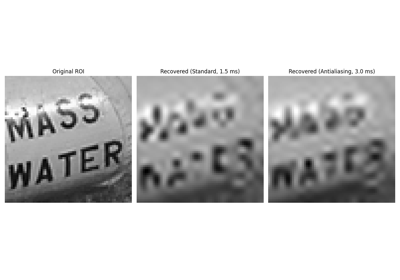
Resize N-D arrays with interpolation or projection antialiasing. Reuse fixed geometry with ResizePlan.
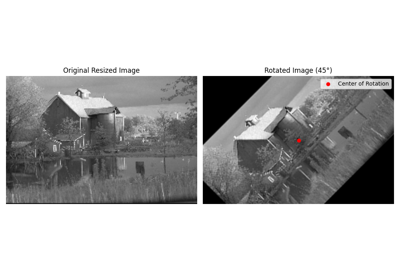
Rotate, shear, scale, and translate 2-D images or 3-D volumes. Share spline coefficients across transforms.
Compute cubic-spline gradients, Hessians, Laplacians, and derived features with explicit physical spacing.
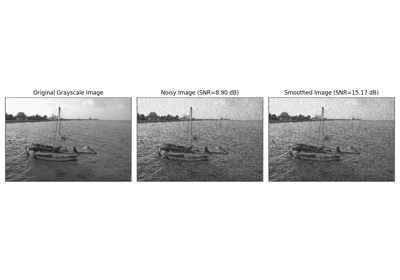
Smooth real signals and arrays with fractional, radial FFT, or recursive methods. Choose the formulation and boundaries explicitly.
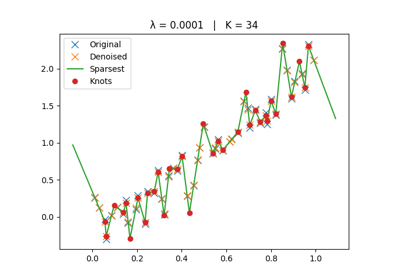
Fit sparse piecewise-linear models to 1-D observations and inspect convergence along a regularization path.
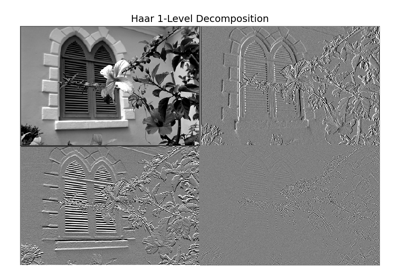
Build spline pyramids and decompose images with Haar or spline wavelets. Order-5 wavelets use documented approximate taps.
See the Examples for runnable illustrations and Reusable workflow recipes for workflows combining several modules.