3-D microvessel quality-at-speed validation#
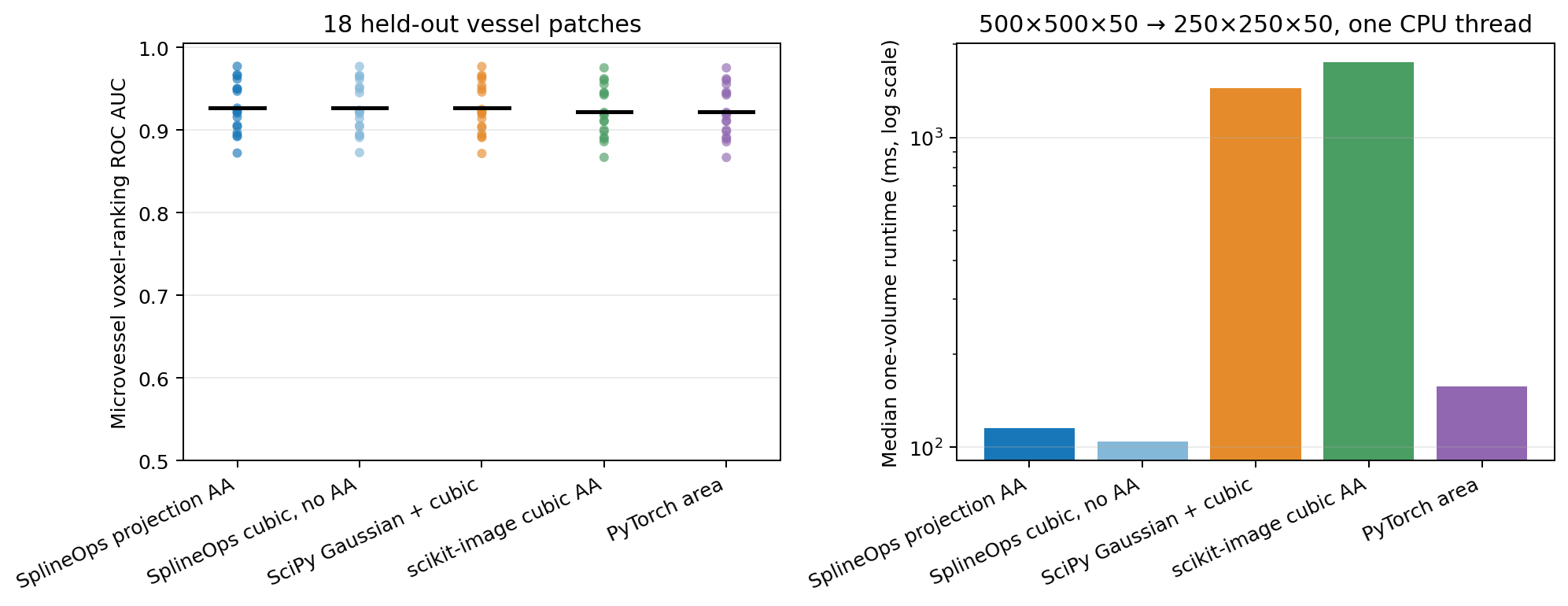
This is the current flagship real-data result. On 18 held-out, expert-labelled light-sheet microscopy patches, SplineOps cubic projection produced higher mean microvessel voxel-ranking AUC than every named external method. A predeclared Bonferroni-controlled rule passed for all three quality comparisons. It was also 12.49 times faster than SciPy Gaussian+cubic, 15.17 times faster than scikit-image cubic antialiasing, and 1.36 times faster than PyTorch area on the recorded one-thread CPU run.
This is narrow superiority, not a universal claim. It covers the exact data, geometry, metric, named pipelines, and machine below. It does not establish better segmentation or better biological conclusions.
What was tested#
The data is the WGA microvessel channel from the annotated VessAP_vessel
subset of SELMA3D S-BIAD1196. It originates from the VesSAP whole-brain
vasculature study. Every input is a 500 by 500 by 50 volume with an expert
vessel mask. The two lateral axes are reduced to 250; the 50-plane axis is
retained. This matches a practical anisotropic microscopy workflow better
than isotropic thumbnail resizing.
Patches 000–005 were used as a disclosed pilot. The WGA channel was selected there before confirmation because it ranked the vessel mask better than the second channel or their per-voxel maximum. Patches 006–023 were then run once as the 18-patch confirmation. The frozen protocol was recorded locally before that run; it was not registered independently.
The tested methods were:
SplineOps endpoint-aligned cubic projection antialiasing;
SplineOps cubic interpolation without antialiasing, as a control;
SciPy Gaussian prefilter plus endpoint-aligned cubic sampling;
scikit-image native half-pixel cubic resize with antialiasing; and
PyTorch native area resize.
Each patch was normalized by its 1st and 99.9th percentiles. No segmentation threshold or learned model was fitted. The primary endpoint was ROC AUC for ranking labelled vessel voxels above background on the reduced grid. Labels were nearest-neighbour sampled on each method’s documented grid.
Confirmation result#
Method |
ROC AUC |
Average precision |
Top-prevalence Dice |
Runtime |
|---|---|---|---|---|
SplineOps projection AA |
0.92737 |
0.70036 |
0.64472 |
115 ms |
SplineOps cubic, no AA |
0.92681 |
0.69912 |
0.64354 |
104 ms |
SciPy Gaussian + cubic |
0.92665 |
0.69669 |
0.64143 |
1,441 ms |
scikit-image cubic AA |
0.92217 |
0.68710 |
0.63394 |
1,750 ms |
PyTorch area |
0.92218 |
0.68668 |
0.63360 |
157 ms |
Average precision and top-prevalence Dice are descriptive secondary metrics. They agree with the primary ranking but were not allowed to rescue a failed ROC-AUC decision.
Comparison |
Mean AUC difference |
Paired 95% interval |
Bonferroni one-sided lower bound |
|---|---|---|---|
SciPy Gaussian + cubic |
+0.000722 |
+0.000115 to +0.001144 |
+0.000053 |
scikit-image cubic AA |
+0.005202 |
+0.004411 to +0.006034 |
+0.004345 |
PyTorch area |
+0.005186 |
+0.004422 to +0.006020 |
+0.004363 |
The one-sided bound used the 1.667th percentile of each paired-bootstrap distribution (alpha 0.05 / 3). All bounds exceed zero, so the frozen strict quality rule passed. The runtime ratios also exceeded their frozen thresholds: at least 10 against SciPy and scikit-image, and greater than 1 against PyTorch area. One individual patch favoured SciPy by about 0.0036 AUC; the claim is an aggregate paired result, not an every-patch win.
What can be claimed#
The defensible statement is:
For the tested twofold lateral coarsening of 18 held-out SELMA3D WGA microvessel patches, SplineOps cubic projection had higher mean vessel- ranking ROC AUC than the named SciPy, scikit-image, and PyTorch pipelines under a predeclared family-wise rule. On the recorded one-thread CPU run it was 12.49 times, 15.17 times, and 1.36 times faster, respectively.
Do not shorten this to “SplineOps is the best image resizer” or “SplineOps segments vessels better.” The study tests preprocessing signal ranking, not a deployed segmenter. It covers one lateral 2x geometry, one channel, one CPU, and four alternatives. A different library, geometry, boundary condition, or downstream task may reverse the ranking.
The canonical reusable wording is maintained in Claims and evidence. The Interactive SELMA3D comparison provides an interactive view while keeping the frozen aggregate result separate from its post-study presentation patch.
Two additional limitations matter. The archive does not expose specimen IDs for the patches, so bootstrap units are patches rather than independent animals. The BioImage Archive page says CC BY 4.0, while the official SELMA3D data page says CC BY-NC. SplineOps follows the stricter CC BY-NC interpretation, cites both SELMA3D and VesSAP, and redistributes no source data.
Reproduce it#
python -m pip install -e '.[selma3d-study]'
python scripts/benchmark_selma3d_vessels.py \
    --output-dir benchmarks/selma3d-vessels
The runner downloads only the 18 confirmation images and masks from EMBL-EBI and verifies a pinned SHA-256 digest for every file. The benchmark script, raw JSON, patch-level scores, repeated timings, and comparison CSV are published. Timings are machine-specific.
The adjacent nuclei study is also retained in benchmarks/selma3d. Its
quality rule passed but its predeclared 10-times speed rule failed. Keeping
that negative decision visible prevents the vascular geometry from looking
like the only case attempted.