
Resize Module 2D#
Shrink and re-expand a 2-D RGB image with splineops, then discuss aliasing.
We start with a minimal example that calls splineops.resize.resize()
directly on a single channel of the image, then move on to an RGB example
with ROIs:
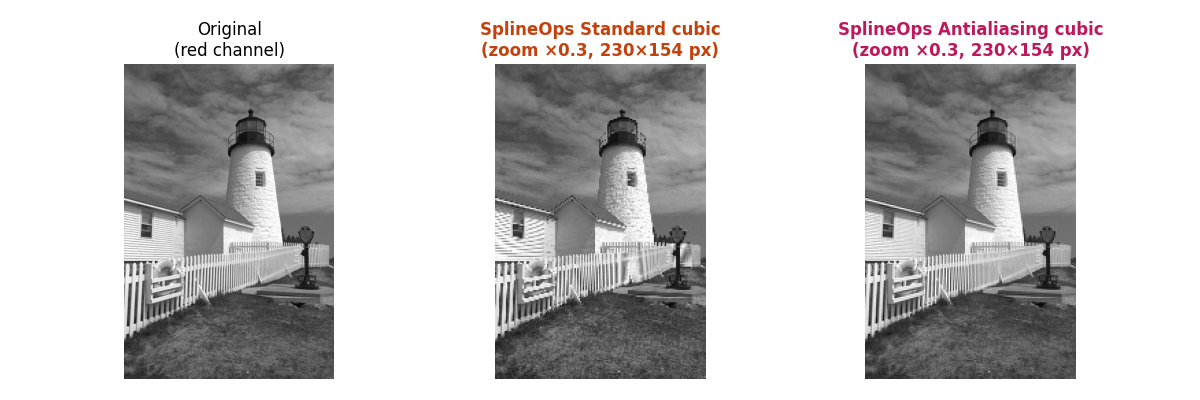
Simple grayscale resize with
resizeon one channel.Pick a zoom factor and a single ROI.
Compare the first-pass shrink for standard cubic interpolation and
cubic-antialiasing.
Aliasing appears when we shrink below the Nyquist limit without proper low-pass filtering: fine details fold back into lower frequencies and show up as Moiré or ripple patterns. The antialiasing preset adds a matched low-pass step to suppress these artefacts.
Imports and Helpers#
import numpy as np
import matplotlib.pyplot as plt
from matplotlib import patches
from urllib.request import urlopen
from PIL import Image

from scipy.ndimage import zoom as ndi_zoom  # kept for reference, not used in 2D plots
from splineops.resize import resize  # core N-D spline resizer

plt.rcParams.update(
    {
        "font.size": 14,
        "axes.titlesize": 18,
        "axes.labelsize": 16,
    }
)

# Use float32 for storage / IO. The native backend chooses validated float32
# scratch for standard cubic and conservative float64 scratch for 2-D AA.
DTYPE = np.float32

STD_LABEL = "SplineOps Standard cubic"
AA_LABEL = "SplineOps Antialiasing cubic"
STD_COLOR = "#C2410C"
AA_COLOR = "#BE185D"


def resize_rgb(
    img: np.ndarray,
    zoom: float,
    *,
    method: str = "cubic",
) -> np.ndarray:
    """
    Resize an H×W×3 RGB image with splineops.resize.resize (channel-wise).

    Parameters
    ----------
    img : ndarray, shape (H, W, 3), values in [0, 1]
    zoom : float
        Isotropic zoom factor (same for H and W).
    method : str
        One of the splineops presets, e.g. "linear", "cubic",
        "cubic-antialiasing", ...

    Returns
    -------
    out : ndarray, shape (H', W', 3)
        Same float dtype as ``img`` (float32 in this example), values in [0, 1].
    """
    if img.ndim != 3 or img.shape[2] != 3:
        raise ValueError("resize_rgb expects an H×W×3 RGB array")

    zoom_hw = (float(zoom), float(zoom))  # (H, W) factors

    channels = []
    for c in range(img.shape[2]):
        ch = resize(
            img[..., c],
            zoom_factors=zoom_hw,
            method=method,
        )
        channels.append(ch)

    out = np.stack(channels, axis=-1)
    return np.clip(out, 0.0, 1.0)


def _roi_rect_from_frac_color(shape, roi_size_px, center_frac):
    """
    Compute a square ROI inside a color image, centered at fractional coordinates.

    Parameters
    ----------
    shape : tuple
        (H, W, 3) shape of the color image.
    roi_size_px : int
        Target side length (clipped to fit inside the image).
    center_frac : tuple of float
        (row_frac, col_frac) in [0, 1] × [0, 1].

    Returns
    -------
    (row_top, col_left, height, width)
    """
    H, W, _ = shape
    row_frac, col_frac = center_frac

    size = int(min(roi_size_px, H, W))
    if size < 1:
        size = min(H, W)

    center_r = int(round(row_frac * H))
    center_c = int(round(col_frac * W))

    row_top = int(np.clip(center_r - size // 2, 0, H - size))
    col_left = int(np.clip(center_c - size // 2, 0, W - size))

    return row_top, col_left, size, size


def _nearest_big_color(roi: np.ndarray, target_h: int = 256) -> np.ndarray:
    """
    Enlarge a small color ROI (H×W×3) with nearest-neighbour so that its
    height is ~target_h pixels.
    """
    h, w, _ = roi.shape
    mag = max(1, int(round(target_h / max(h, 1))))
    return np.repeat(np.repeat(roi, mag, axis=0), mag, axis=1)


def show_intro_color(
    original_uint8: np.ndarray,
    shrunk_uint8: np.ndarray,
    roi_rect,
    zoom: float,
    label: str,
    degree_label: str,
) -> None:
    """
    2×2 figure with the same wording style as the benchmarking intro:

    Row 1:
      - Original image with ROI (H×W px)
      - Original ROI (h×w px, NN magnified)

    Row 2:
      - First-pass resized image on a white canvas, with mapped ROI box
      - First-pass ROI (h'×w' px, NN magnified)
    """
    H, W, _ = original_uint8.shape
    row0, col0, roi_h, roi_w = roi_rect

    # Original ROI and its NN magnification
    roi_orig = original_uint8[row0 : row0 + roi_h, col0 : col0 + roi_w, :]
    roi_orig_big = _nearest_big_color(roi_orig, target_h=256)

    # Shrunk image geometry
    Hs, Ws, _ = shrunk_uint8.shape
    center_r = row0 + roi_h / 2.0
    center_c = col0 + roi_w / 2.0

    roi_h_res = max(1, int(round(roi_h * zoom)))
    roi_w_res = max(1, int(round(roi_w * zoom)))

    if roi_h_res > Hs or roi_w_res > Ws:
        roi_shrunk = shrunk_uint8
        row_top_res = 0
        col_left_res = 0
        roi_h_res = Hs
        roi_w_res = Ws
    else:
        center_r_res = int(round(center_r * zoom))
        center_c_res = int(round(center_c * zoom))
        row_top_res = int(np.clip(center_r_res - roi_h_res // 2, 0, Hs - roi_h_res))
        col_left_res = int(np.clip(center_c_res - roi_w_res // 2, 0, Ws - roi_w_res))
        roi_shrunk = shrunk_uint8[
            row_top_res : row_top_res + roi_h_res,
            col_left_res : col_left_res + roi_w_res,
            :,
        ]

    roi_shrunk_big = _nearest_big_color(roi_shrunk, target_h=256)

    # Place shrunk image on a white canvas of the same size as original
    canvas = np.full_like(original_uint8, 255)
    h_copy = min(H, Hs)
    w_copy = min(W, Ws)
    canvas[:h_copy, :w_copy, :] = shrunk_uint8[:h_copy, :w_copy, :]

    fig, axes = plt.subplots(2, 2, figsize=(10, 8))

    # Row 1, left: original with ROI box
    ax = axes[0, 0]
    ax.imshow(original_uint8)
    rect = patches.Rectangle(
        (col0, row0),
        roi_w,
        roi_h,
        linewidth=2,
        edgecolor="red",
        facecolor="none",
    )
    ax.add_patch(rect)
    ax.set_title(
        f"Original image with ROI ({H}×{W} px)",
        fontsize=12,
    )
    ax.axis("off")

    # Row 1, right: magnified original ROI
    ax = axes[0, 1]
    ax.imshow(roi_orig_big)
    ax.set_title(
        f"Original ROI ({roi_h}×{roi_w} px, NN magnified)",
        fontsize=12,
    )
    ax.axis("off")

    # Row 2, left: first-pass resized image on canvas with mapped ROI box
    ax = axes[1, 0]
    ax.imshow(canvas)
    if row_top_res < h_copy and col_left_res < w_copy:
        box_h = min(roi_h_res, h_copy - row_top_res)
        box_w = min(roi_w_res, w_copy - col_left_res)
        rect2 = patches.Rectangle(
            (col_left_res, row_top_res),
            box_w,
            box_h,
            linewidth=2,
            edgecolor="red",
            facecolor="none",
        )
        ax.add_patch(rect2)
    # Row 2, left: first-pass resized image on canvas with mapped ROI box
    if label.lower().startswith("standard"):
        ax.set_title(
            f"{STD_LABEL}\n(zoom ×{zoom:g}, {Hs}×{Ws} px)",
            fontsize=12,
            color=STD_COLOR,
            fontweight="bold",
            multialignment="center",
        )

    elif label.lower().startswith("antialiasing"):
        ax.set_title(
            f"{AA_LABEL}\n(zoom ×{zoom:g}, {Hs}×{Ws} px)",
            fontsize=12,
            color=AA_COLOR,
            fontweight="bold",
            multialignment="center",
        )
    else:
        ax.set_title(
            f"{label} ({degree_label}, zoom ×{zoom:g}, {Hs}×{Ws} px)",
            fontsize=12,
        )
    ax.axis("off")

    # Row 2, right: magnified resized ROI
    ax = axes[1, 1]
    ax.imshow(roi_shrunk_big)
    # Row 2, right: magnified resized ROI
    if label.lower().startswith("standard"):
        title_kw = dict(fontsize=12, color=STD_COLOR, fontweight="bold")
        ax.set_title(
            f"{label} ROI ({roi_h_res}×{roi_w_res} px, NN magnified)",
            **title_kw,
        )

    elif label.lower().startswith("antialiasing"):
        title_kw = dict(fontsize=12, color=AA_COLOR, fontweight="bold")
        ax.set_title(
            f"{label} ROI ({roi_h_res}×{roi_w_res} px, NN magnified)",
            **title_kw,
        )

    else:
        ax.set_title(
            f"{label} ROI ({roi_h_res}×{roi_w_res} px, NN magnified)",
            fontsize=12,
        )
    ax.axis("off")

    fig.tight_layout()
    plt.show()
Load and Normalize an Image#
We now move to a real 2D example using a Kodak color image. The data is stored as float32 in [0, 1] for splineops.
url = "https://r0k.us/graphics/kodak/kodak/kodim19.png"
with urlopen(url, timeout=10) as resp:
    img = Image.open(resp)
data = np.asarray(img, dtype=DTYPE) / DTYPE(255.0)  # H × W × 3, range [0, 1]
data_uint8 = (np.clip(data, 0.0, 1.0) * 255).astype(np.uint8)

H0, W0, _ = data_uint8.shape
print(f"Loaded kodim19: shape={H0}×{W0} px")
Loaded kodim19: shape=768×512 px
Simple 2D Resize Call#
Before using helpers and ROIs, we start with a minimal example that calls
splineops.resize.resize() directly on a single (grayscale) channel.
This highlights the basic API: you provide an array, per-axis zoom factors,
and a method string.
# Take a single channel (e.g., red) to keep things simple
gray = data[..., 0]  # shape H×W, values in [0, 1]

simple_zoom = 0.3  # shrink by a factor of 0.3 in each direction

gray_cubic = resize(
    gray,
    zoom_factors=(simple_zoom, simple_zoom),
    method="cubic",
)

gray_aa = resize(
    gray,
    zoom_factors=(simple_zoom, simple_zoom),
    method="cubic-antialiasing",
)

TITLE_FS = 12

fig, axes = plt.subplots(1, 3, figsize=(12, 4))
axes[0].imshow(gray, cmap="gray", vmin=0.0, vmax=1.0)
axes[0].set_title(
    "Original\n(red channel)",
    fontsize=TITLE_FS,
    multialignment="center",
)
axes[1].imshow(gray_cubic, cmap="gray", vmin=0.0, vmax=1.0)
axes[1].set_title(
    f"{STD_LABEL}\n(zoom ×{simple_zoom:g}, {gray_cubic.shape[0]}×{gray_cubic.shape[1]} px)",
    fontsize=TITLE_FS,
    color=STD_COLOR,
    fontweight="bold",
    multialignment="center",
)
axes[2].imshow(gray_aa, cmap="gray", vmin=0.0, vmax=1.0)
axes[2].set_title(
    f"{AA_LABEL}\n(zoom ×{simple_zoom:g}, {gray_aa.shape[0]}×{gray_aa.shape[1]} px)",
    fontsize=TITLE_FS,
    color=AA_COLOR,
    fontweight="bold",
    multialignment="center",
)
for ax in axes:
    ax.axis("off")
fig.tight_layout()
plt.show()
ROI and RGB Shrink With Antialiasing#
We now follow the same spirit as the benchmarking intro:
Pick a zoom factor.
Pick a single ROI.
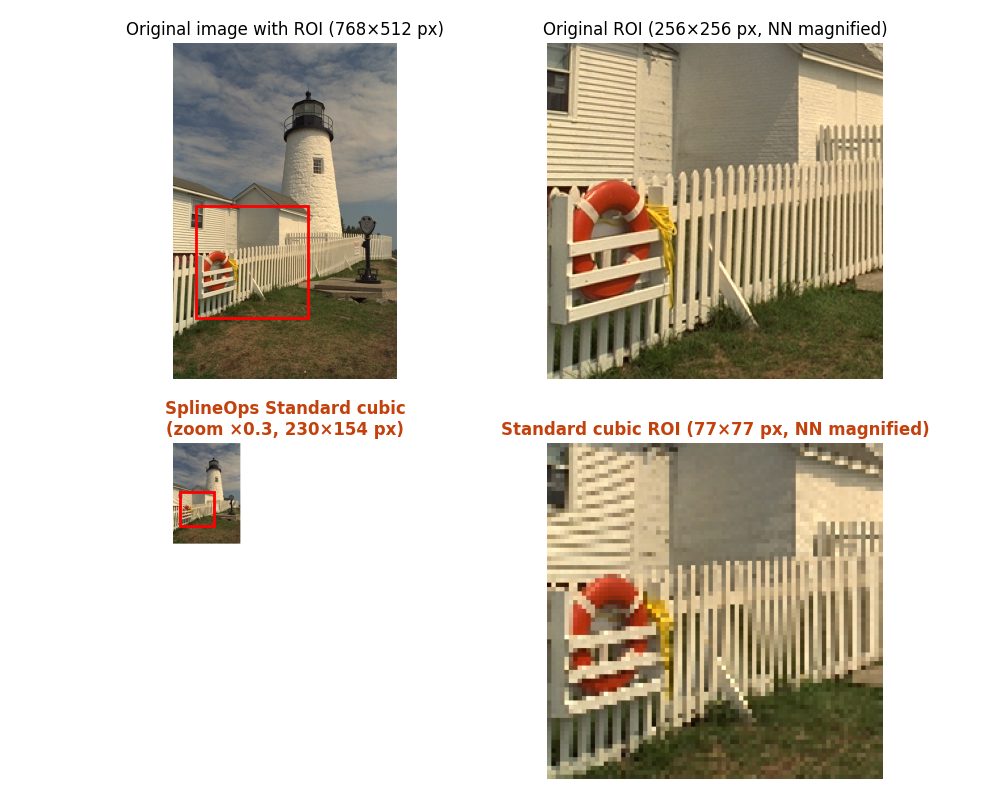
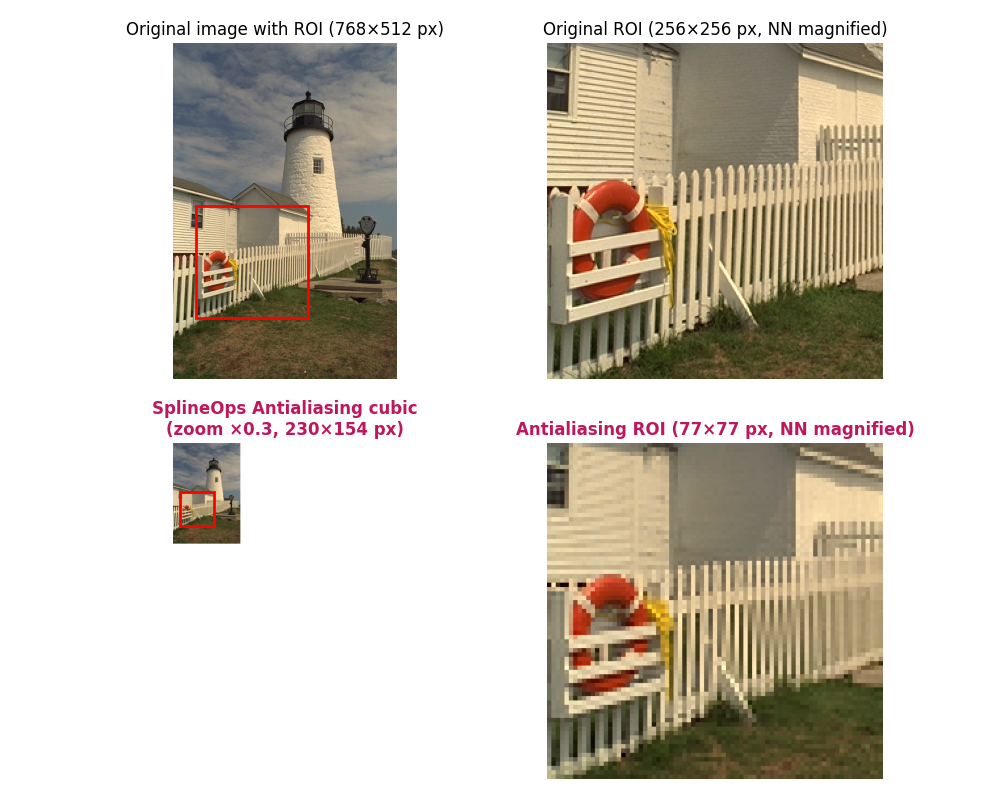
Compare the first-pass shrink for standard cubic interpolation and antialiasing on the full RGB image.
# Use the same ROI position as in the benchmarking example for kodim19
ROI_SIZE_PX = 256
ROI_CENTER_FRAC = (0.65, 0.35)
roi_rect = _roi_rect_from_frac_color(data_uint8.shape, ROI_SIZE_PX, ROI_CENTER_FRAC)

# Shrink factor (same spirit as in other 2D examples)
shrink_factor = 0.3

# 3) Shrink with splineops (channel-wise): standard cubic
shrunken_cubic_f = resize_rgb(
    data,
    shrink_factor,
    method="cubic",  # plain cubic interpolation (no explicit anti-aliasing)
)
shrunken_cubic = (np.clip(shrunken_cubic_f, 0.0, 1.0) * 255).astype(np.uint8)

# 4) Shrink with splineops: cubic-antialiasing
shrunken_aa_f = resize_rgb(
    data,
    shrink_factor,
    method="cubic-antialiasing",  # antialiasing shrink, degree 3
)
shrunken_aa = (np.clip(shrunken_aa_f, 0.0, 1.0) * 255).astype(np.uint8)
Standard Cubic Shrink#
Standard cubic interpolation gives a smooth-looking small image, but it does not apply an explicit low-pass before decimation. High-frequency content from the original folds back (aliases) into lower frequencies, which can be spotted as spurious ripples or Moiré patterns in the ROI.
show_intro_color(
    original_uint8=data_uint8,
    shrunk_uint8=shrunken_cubic,
    roi_rect=roi_rect,
    zoom=shrink_factor,
    label="Standard cubic",
    degree_label="Cubic",
)
Cubic-Antialiasing Shrink#
The “cubic-antialiasing” preset inserts a projection-based low-pass filter before shrinking. The zoomed ROI shows that most of the Moiré pattern is removed, while larger-scale edges and contrast are preserved.
show_intro_color(
    original_uint8=data_uint8,
    shrunk_uint8=shrunken_aa,
    roi_rect=roi_rect,
    zoom=shrink_factor,
    label="Antialiasing",
    degree_label="Cubic",
)
Animation: Cubic vs Cubic-Antialiasing#
Side-by-side comparison over a zoom sweep. The animation starts at z=0.30 and then goes downwards.
Row 1: Original (fixed) + Downsampled (on white canvas) Row 2: Recovered (round-trip) Row 3: Signed error (rec−orig), normalized with a shared scale
from matplotlib import animation

METHOD_STD = "cubic"
METHOD_AA = "cubic-antialiasing"

INTERVAL_MS = 900
TITLE_FS = 12
Z_START = 0.30

# --- Zoom values: keep the original distribution, but start the animation at Z_START
zoom_low = np.geomspace(0.01, 0.15, 6, endpoint=False)  # < 0.15
zoom_focus = np.geomspace(0.15, 0.50, 22, endpoint=False)  # [0.15, 0.50)
zoom_mid = np.geomspace(0.50, 0.80, 6, endpoint=True)  # [0.50, 0.80]
zoom_top = np.array([0.85, 0.90, 0.95, 1.0])

zoom_values_full = np.sort(
    np.unique(np.concatenate([zoom_low, zoom_focus, zoom_mid, zoom_top, [Z_START]]))
)[
    ::-1
]  # 1.0 -> ... -> small

start_idx = int(np.where(zoom_values_full <= Z_START)[0][0])

tail = zoom_values_full[start_idx:]  # Z_START -> ... -> small
head = zoom_values_full[: start_idx + 1]  # 1.0 -> ... -> Z_START

# Final sequence: 0.30 -> ... -> 0.01 -> 1.0 -> ... -> 0.30
zoom_values_cmp = np.concatenate([tail, head]).astype(float)

orig_f = np.clip(data, 0.0, 1.0)
H0, W0, _ = orig_f.shape
orig_u8 = (orig_f * 255.0 + 0.5).astype(np.uint8)


# --- Precompute frames (store uint8 to keep memory low) ---------------------
def _roundtrip_frames(method: str):
    canv: list[np.ndarray] = []
    recs: list[np.ndarray] = []
    for z in zoom_values_cmp:
        # Downsample
        down_f = resize_rgb(orig_f, z, method=method)
        down_f = np.clip(down_f, 0.0, 1.0)
        down_u8 = (down_f * 255.0 + 0.5).astype(np.uint8)

        # Canvas (white, original size)
        canvas = np.full_like(orig_u8, 255)
        h1, w1, _ = down_u8.shape
        canvas[:h1, :w1, :] = down_u8
        canv.append(canvas)

        # Recover (round-trip)
        rec_channels = [
            resize(down_f[..., c], output_size=(H0, W0), method=method)
            for c in range(3)
        ]
        rec_f = np.clip(np.stack(rec_channels, axis=-1), 0.0, 1.0)
        rec_u8 = (rec_f * 255.0 + 0.5).astype(np.uint8)
        recs.append(rec_u8)

    return canv, recs


canv_std, recs_std = _roundtrip_frames(METHOD_STD)
canv_aa, recs_aa = _roundtrip_frames(METHOD_AA)


# --- Signed normalized error maps (shared scale across BOTH methods + frames) ---
def _u8_to_gray01(u8_rgb: np.ndarray) -> np.ndarray:
    u = u8_rgb.astype(np.float32) / 255.0
    return (0.2989 * u[..., 0] + 0.5870 * u[..., 1] + 0.1140 * u[..., 2]).astype(
        np.float32
    )


orig_gray01 = _u8_to_gray01(orig_u8)
orig_energy = float(np.sum(orig_gray01.astype(np.float64) ** 2))


def _diff01(rec_u8: np.ndarray) -> np.ndarray:
    return _u8_to_gray01(rec_u8) - orig_gray01  # signed


max_abs = 0.0
for r in recs_std + recs_aa:
    max_abs = max(max_abs, float(np.max(np.abs(_diff01(r)))))
max_abs = max(max_abs, 1e-12)


def _diff_norm(rec_u8: np.ndarray) -> np.ndarray:
    d = _diff01(rec_u8)
    n = 0.5 + 0.5 * (d / max_abs)
    return np.clip(n, 0.0, 1.0).astype(np.float32)


diffs_std = [_diff_norm(r) for r in recs_std]
diffs_aa = [_diff_norm(r) for r in recs_aa]


# --- SNR per frame (grayscale), shown in the recovered titles -----------------
def _snr_db_from_rec(rec_u8: np.ndarray) -> float:
    d = _diff01(rec_u8).astype(np.float64, copy=False)
    den = float(np.sum(d * d))
    if den == 0.0:
        return float("inf")
    if orig_energy == 0.0:
        return -float("inf")
    return 10.0 * float(np.log10(orig_energy / den))


def _fmt_snr(v: float) -> str:
    if np.isposinf(v):
        return "∞"
    if np.isneginf(v):
        return "-∞"
    return f"{v:.2f} dB"


snr_std = [_snr_db_from_rec(r) for r in recs_std]
snr_aa = [_snr_db_from_rec(r) for r in recs_aa]

# --- Layout: 3 columns (Original | Std | AA), 3 rows (Down | Rec | Error) ----
fig = plt.figure(figsize=(13, 9), constrained_layout=True)
gs = fig.add_gridspec(nrows=3, ncols=3, width_ratios=[1.05, 1.0, 1.0])

ax_orig = fig.add_subplot(gs[0, 0])
ax_orig_mid = fig.add_subplot(gs[1, 0])  # spacer -> used as row label ("Recovered")
ax_orig_err = fig.add_subplot(gs[2, 0])  # legend host

ax_down_std = fig.add_subplot(gs[0, 1])
ax_down_aa = fig.add_subplot(gs[0, 2])
ax_rec_std = fig.add_subplot(gs[1, 1])
ax_rec_aa = fig.add_subplot(gs[1, 2])
ax_err_std = fig.add_subplot(gs[2, 1])
ax_err_aa = fig.add_subplot(gs[2, 2])

for ax in (
    ax_orig,
    ax_orig_mid,
    ax_orig_err,
    ax_down_std,
    ax_down_aa,
    ax_rec_std,
    ax_rec_aa,
    ax_err_std,
    ax_err_aa,
):
    ax.axis("off")

# Row label for recovered row
ax_orig_mid.text(
    0.5,
    0.5,
    "Recovered",
    transform=ax_orig_mid.transAxes,
    ha="center",
    va="center",
    fontsize=TITLE_FS,
)

# --- Legend bar in bottom-left cell ------------------------------------------
ax_leg_host = ax_orig_err
ax_leg_host.axis("off")

leg = ax_leg_host.inset_axes([0.42, 0.05, 0.18, 0.90])
leg.axis("off")

H_leg = 256
W_leg = 16
y = np.linspace(1.0, 0.0, H_leg, dtype=np.float32)
legend_img = np.repeat(y[:, None], W_leg, axis=1)
leg.imshow(legend_img, cmap="gray", vmin=0.0, vmax=1.0, aspect="auto")

ax_leg_host.text(
    0.62,
    0.05,
    "-1",
    transform=ax_leg_host.transAxes,
    fontsize=9,
    va="bottom",
    ha="left",
)
ax_leg_host.text(
    0.62, 0.50, "0", transform=ax_leg_host.transAxes, fontsize=9, va="center", ha="left"
)
ax_leg_host.text(
    0.62, 0.95, "+1", transform=ax_leg_host.transAxes, fontsize=9, va="top", ha="left"
)
ax_leg_host.text(
    0.50,
    1.02,
    "Diff legend",
    transform=ax_leg_host.transAxes,
    fontsize=TITLE_FS,
    va="bottom",
    ha="center",
)

# Titles / images
ax_orig.set_title("Original", fontsize=TITLE_FS)
ax_orig.imshow(orig_u8)

STD_COLOR = "#C2410C"
AA_COLOR = "#BE185D"

STD_LABEL = "SplineOps Standard cubic"
AA_LABEL = "SplineOps Antialiasing cubic"

# Row 1: Downsampled
t_down_std = ax_down_std.set_title(
    f"{STD_LABEL} (z={zoom_values_cmp[0]:.3f})",
    fontsize=TITLE_FS,
    color=STD_COLOR,
    fontweight="bold",
)
t_down_aa = ax_down_aa.set_title(
    f"{AA_LABEL} (z={zoom_values_cmp[0]:.3f})",
    fontsize=TITLE_FS,
    color=AA_COLOR,
    fontweight="bold",
)

im_down_std = ax_down_std.imshow(canv_std[0])
im_down_aa = ax_down_aa.imshow(canv_aa[0])

# Row 2: Recovered (no "Recovered," prefix)
t_rec_std = ax_rec_std.set_title(
    f"{STD_LABEL} (SNR={_fmt_snr(snr_std[0])})",
    fontsize=TITLE_FS,
    color=STD_COLOR,
    fontweight="bold",
)
t_rec_aa = ax_rec_aa.set_title(
    f"{AA_LABEL} (SNR={_fmt_snr(snr_aa[0])})",
    fontsize=TITLE_FS,
    color=AA_COLOR,
    fontweight="bold",
)
im_rec_std = ax_rec_std.imshow(recs_std[0])
im_rec_aa = ax_rec_aa.imshow(recs_aa[0])

# Row 3: Signed error (shared scale already baked into diffs_*)
ax_err_std.set_title("Signed error", fontsize=TITLE_FS)
ax_err_aa.set_title("Signed error", fontsize=TITLE_FS)
im_err_std = ax_err_std.imshow(diffs_std[0], cmap="gray", vmin=0.0, vmax=1.0)
im_err_aa = ax_err_aa.imshow(diffs_aa[0], cmap="gray", vmin=0.0, vmax=1.0)


def animate_frame(i: int):
    z = float(zoom_values_cmp[i])

    im_down_std.set_data(canv_std[i])
    im_down_aa.set_data(canv_aa[i])

    im_rec_std.set_data(recs_std[i])
    im_rec_aa.set_data(recs_aa[i])

    im_err_std.set_data(diffs_std[i])
    im_err_aa.set_data(diffs_aa[i])

    t_down_std.set_text(f"{STD_LABEL} (z={z:.3f})")
    t_down_aa.set_text(f"{AA_LABEL} (z={z:.3f})")

    t_rec_std.set_text(f"{STD_LABEL} (SNR={_fmt_snr(snr_std[i])})")
    t_rec_aa.set_text(f"{AA_LABEL} (SNR={_fmt_snr(snr_aa[i])})")

    return (
        im_down_std,
        im_down_aa,
        im_rec_std,
        im_rec_aa,
        im_err_std,
        im_err_aa,
        t_down_std,
        t_down_aa,
        t_rec_std,
        t_rec_aa,
    )


ani_cmp = animation.FuncAnimation(
    fig,
    animate_frame,
    frames=len(zoom_values_cmp),
    interval=INTERVAL_MS,
    blit=True,
)
Export Animation#
Writes into: <generated static dir>/_static/animations/ No-op when run normally by users.
from splineops.utils.sphinx import export_animation_mp4_and_html

export_animation_mp4_and_html(
    ani_cmp,
    stem="resize_module_2d_cubic_vs_aa",
    interval_ms=INTERVAL_MS,
    dpi=80,
    force=True,
)
(PosixPath('/home/runner/work/splineops/splineops/docs/_build/_generated_static/animations/resize_module_2d_cubic_vs_aa.mp4'), PosixPath('/home/runner/work/splineops/splineops/docs/_build/_generated_static/animations/resize_module_2d_cubic_vs_aa.html'))
Total running time of the script: (1 minutes 10.842 seconds)
